 Spreadsheet
What does a 1 kg parcel to the US actually cost?
$38.07
available US 1 kg example, 10 October 2026
operator's own estimator, read 10 October 2026
Compare routes using the actual goods, packed weight and dimensions. Historical quotes and customs reference tables need a current check before you budget.
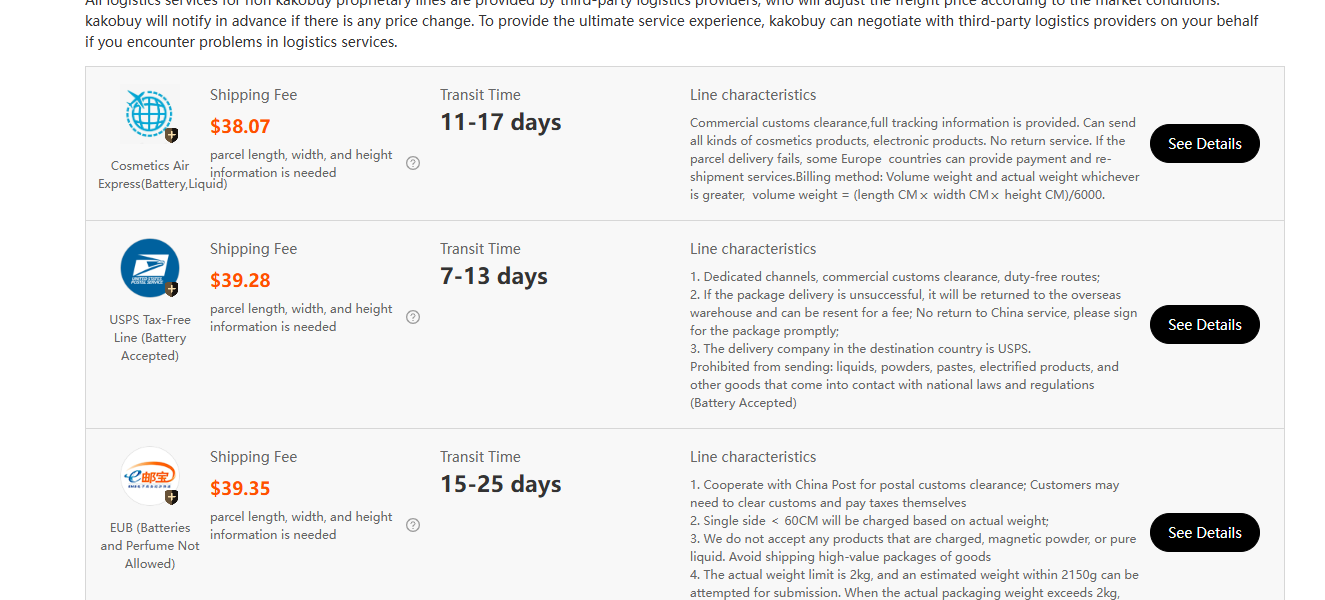
The estimator is public and needs no account. Enter destination, weight and optionally dimensions, and it returns a list of lines with a price, a transit window and a characteristics note. The notes are the useful part: they say which lines are duty-free, which refuse batteries or liquids, which will not return a failed delivery to China, and which bill by volumetric weight.
The official estimator on 10 October 2026 showed available US 1 kg examples from $38.07 to $52.80. The $38.07 option indicated 11–17 days, and a $39.28 option indicated 7–13 days. These are dated route examples, not present quotes or delivery guarantees.
The estimator page also carries the operator's own warning that non-proprietary lines are run by third-party logistics providers who adjust prices with the market. That sentence is why no freight number on this site is printed without the date it was read.
What does a 1 kg parcel to the US actually cost?
$38.07
available US 1 kg example, 10 October 2026
operator's own estimator, read 10 October 2026
Some routes in the retained estimator had minimum weights, such as 2000 g. Other routes were available for 1 kg, including the $38.07 example. Check each route’s eligibility instead of applying one route’s minimum to the whole destination.
On a route using volumetric billing, compare packed actual weight against length × width × height in centimetres divided by the route’s divisor. The official help gives 5000, 6000, 7000 or 8000 as possible divisors. Actual-weight-only routes also exist; minimums and rounding are separate. Item net weight is not the packed parcel weight.
For example, a 40 × 30 × 20 cm carton has a volume of 24,000 cm³. Its volumetric weight is 4 kg at divisor 6000, or 3 kg at 8000. On a volumetric route with packed actual weight 2.5 kg, those comparisons give 4 or 3 kg before route minimums and rounding. An actual-weight-only route follows different billing rules.
Which divisor is used for volumetric weight?
5000, 6000, 7000 or 8000
set by the logistics provider, not the agent
Kakobuy help centre, article 26
Consolidation can reduce repeated packaging and dispatch charges, but a larger carton can increase volumetric weight or exceed route limits. Compare the packed options before choosing.
The help centre publishes a threshold table for eleven countries. Directly underneath it the operator writes that the information is collected from internet data, is only for reference, and cannot be the standard guidance. It is the most honest sentence on the site and the least quoted one.
The retained table contains legacy country thresholds and inconsistent regional entries. Do not use it to determine a current exemption, tax bill or declaration value. Check the destination customs authority and the exact route conditions.
The operator also warns that weight and quantities can affect customs treatment. A parcel below 10 kg is not automatically exempt or guaranteed to be treated as personal. Declare accurately and follow the applicable rules.
At what value does my country start charging duty?
Historical reference table
Kakobuy help centre, article 69
What did the June 2026 EU shipping notice offer?
EUR 3 per parcel
operator notice dated 23 June 2026
Kakobuy announcement, 23 June 2026
The operator’s 23 June 2026 notice described a EUR 3 per parcel arrangement, including a withdrawal clause. This is evidence of a dated operator offer, not a complete statement of current EU customs law. Confirm the selected route and checkout charges before relying on it.
Insurance is bought when you submit the parcel, not afterwards. Three covers exist: delay, customs hold, and loss or damage. Delay cover pays 20% of the shipping fee once the parcel passes 30 or 40 days from dispatch depending on the route. Loss and damage pay by route criteria with a ceiling.
The retained promotional headline and the detailed policy have different scopes. Delay compensation is conditional and is not a universal promise of full compensation.
If the parcel is late, what does the insurance pay?
20% of the shipping fee
eligible insured routes; policy conditions apply
Kakobuy help centre, article 123
On non duty-free routes the operator states that clearance cost is borne by the recipient, that customs may ask you directly for invoices, and that proof of payment means a screenshot of the payment order. If your route is not duty-free, keep that screenshot before the parcel ships, not after customs asks.
Compensation is calculated on actual shipping fee plus actual value of the goods, capped at the insured amount, and route-specific criteria sit behind the green icon under each route on the submission page. If you are paid for a delay and the parcel is then lost, the delay payment is deducted from the final settlement rather than added to it.
The exclusions are where this becomes practical. Delay cover does not pay for delays caused by weather, epidemics, conflict along the route, customs inspection, or the recipient not cooperating with clearance or taxes. Loss cover does not pay when the parcel was returned or destroyed because nobody signed for it. Customs hold cover does not pay when the hold exists because the recipient did not pay the tax. Read together, the three disclaimers all point the same way: anything that depends on the recipient is the recipient's problem.
The operator lists four reasons, and three of them are things you control. The first is size: if the parcel still exceeds the dimensional limit of your chosen line after the warehouse has compressed and repacked it, it is returned to storage and you are told by internal message. The second is a third-party carrier judging it unsendable, or customs returning it for something other than contraband, where the next action depends on the reason and available routes. Ask support to confirm any new route, charge and resubmission requirement before proceeding.
The third and fourth are address and contact details. A wrong address or a refusal to cooperate with destination customs sends it back. So does a missing or invalid phone number, because the destination carrier has no way to reach you for clearance or delivery. A parcel that cannot be delivered and cannot be returned gets disposed of, and the cost of that falls on the recipient.
Some destinations also require a tax identification number before the parcel can ship at all, with the format specified per country. Chile needs a RUT in the form 12.345.678-9; Brazil needs its own number in a different format. Fill that in once in your account rather than discovering it at submission.
Separate from insurance and separate from customs, some goods cannot be exported from China regardless of which line you pick. The operator reproduces the national list, which covers weapons and replica weapons, counterfeit currency, narcotics, potent poisons, material harmful to public morals, plants and animals carrying pests or disease, and food or medicine from infected areas. The export side adds state secrets, precious cultural relics, and endangered species including specimens, seeds and propagation material.
Route notes add restrictions for batteries, liquids, powders, pastes and magnetic items. A broad “liquids” or “cosmetics” label does not establish acceptance of a specific perfume, alcohol content or battery. Ask about the exact goods and route before purchase.
Check this before you buy, not after the warehouse has your item. If no eligible route remains, contact support before the order’s actual storage deadline; normal and abnormal packages have different clocks.